

How to Rank in LLMs: The New Visibility Playbook for Retailers
In the age of AI-driven shopping, traditional SEO is no longer enough. Large Language Models (LLMs) like ChatGPT and Google’s AI summaries now decide what products shoppers see. If your product data isn’t clear, structured, and machine-readable, your listings could be ignored entirely. Here’s what you need to know:
- AI prioritizes reasoning over keywords: LLMs recommend products they can logically evaluate. Content that explains “why” a product fits a need performs better than simple descriptions.
- Structured data is critical: Use JSON-LD for product details, pricing, reviews, and FAQs. AI systems rely on this to understand and trust your products.
- Consistency builds trust: Ensure your product data matches across feeds, pages, and platforms. Conflicting information reduces AI confidence in your listings.
- Detailed attributes win: Include specifics like size, material, and use cases. Products with vague descriptions are excluded from AI recommendations.
- AI-generated content fills gaps: Tools can enrich sparse data with detailed comparisons, FAQs, and reasoning-based insights.
AI search systems are reshaping e-commerce visibility. To stay competitive, focus on creating clear, well-structured product data that AI can easily interpret.
How LLMs Decide Which Products to Surface
LLMs Read for Meaning, Not Keywords
LLMs focus on understanding what a product does and who it’s for, rather than just matching keywords. For instance, if someone asks ChatGPT for “trail running shoes for rocky terrain”, the system identifies key factors like durability and surface compatibility, then filters products that meet those criteria. This marks a shift from simple keyword matching to semantic reasoning.
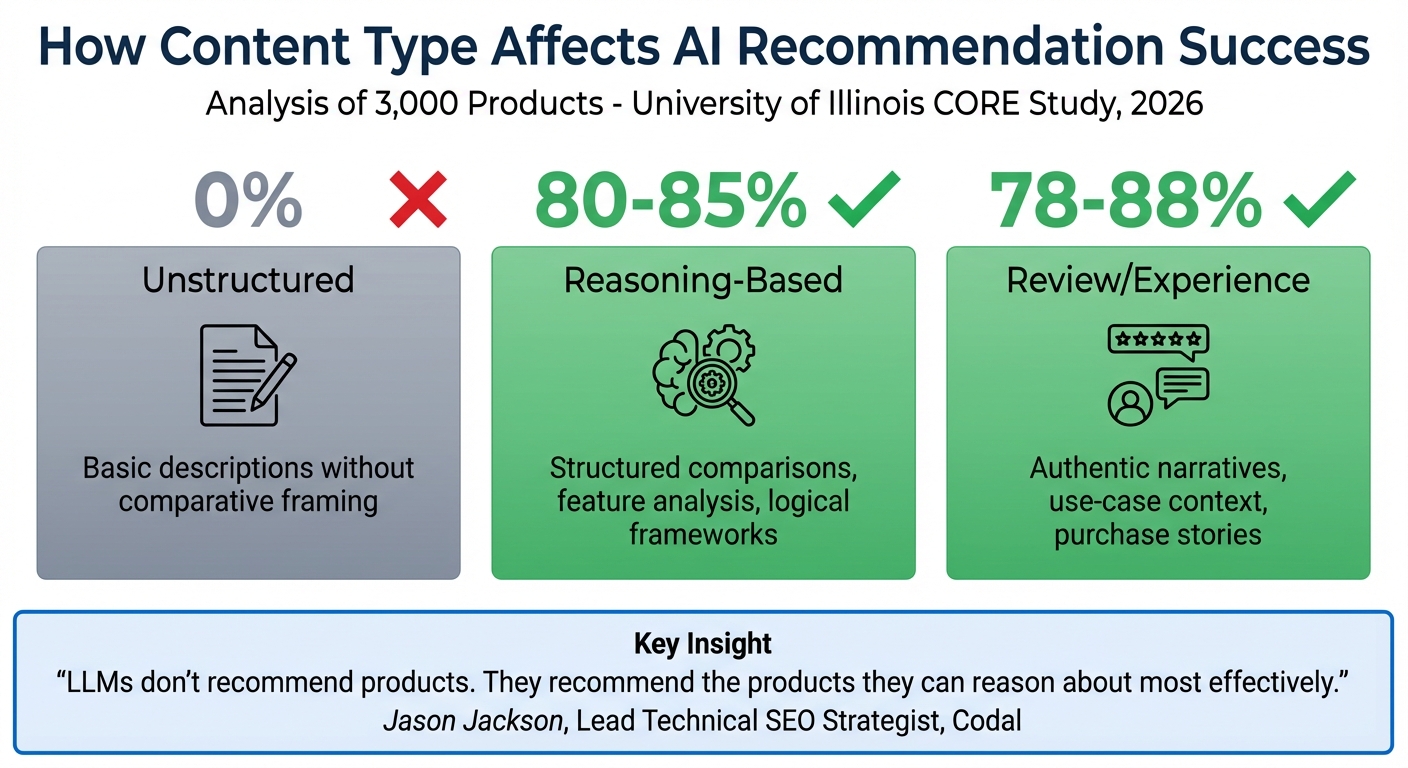
Here’s how it works: LLMs first gather relevant pages via search engines and then re-rank them based on their ability to reason about the content. A study conducted by the University of Illinois in 2026 analyzed 3,000 products and found that content featuring structured comparisons and feature analysis had an 80–85% chance of being promoted as a top recommendation. On the other hand, products with unstructured descriptions had a 0% success rate.
“LLMs don’t recommend products. They recommend the products they can reason about most effectively. Your content needs to do the reasoning for them.” – Jason Jackson, Lead Technical SEO Strategist, Codal
This underscores the importance of crafting product descriptions that explain why a product is suitable for a specific need, rather than just listing features. For example, instead of simply stating “8-quart capacity”, you could write, “ideal for small kitchens compared to larger 12-quart models.” This kind of comparative framing equips the AI with logical reasoning to support its recommendations. This shift in focus also influences how LLMs evaluate overall data reliability.
How LLMs Assess Brand Trust and Data Quality
AI systems rely on consistency across multiple data sources to decide which products to recommend. They build a “confidence score” by cross-checking your product feed, structured data, and third-party references like Reddit discussions or expert reviews. If the data is inconsistent across platforms, the AI loses trust, leading to complete exclusion from recommendations.
LLMs also look for indicators that a product is “safe to cite.” These include clear shipping and return policies, visible contact details, and genuine reviews that go beyond generic star ratings. Essentially, the AI needs to trust your data before suggesting your product. As Vishal Verma, Co-Founder of Shopthru.ai, explains:
“SEO tolerates ambiguity. AI filtering does not.”
This is where entity recognition plays a critical role. LLMs evaluate product “entities” rather than URLs, using data from feeds, schema, and consistent attributes to establish a product’s identity. Uniform product identifiers help consolidate these signals, creating a trustworthy profile for the product. Once trust is established, the richness of the content becomes the deciding factor for AI-generated recommendations.
Why Detailed Content Performs Better in AI Search
Detailed content is the key to standing out in AI-driven searches. LLMs rely on specific details – such as materials, dimensions, or certifications – to make informed recommendations. If this information is hidden in images or PDFs, the AI simply can’t process it. Products with vague or incomplete descriptions are ignored. During the synthesis stage, richly detailed content is essential for helping LLMs form accurate recommendations.
The same University of Illinois study revealed that review-based content, which provides authentic use-case scenarios and purchase narratives, achieved Top-1 promotion rates between 78% and 88%. These high-performing reviews include comparative insights like “better battery life than Brand X” or specific use-case details that help the AI reason about the product in practical terms.
Different LLMs prioritize different types of signals. For example, GPT-4o and Claude focus on structured reasoning and logical comparisons, while Gemini and Grok respond more to experience-driven narratives and authentic reviews. However, the trend is consistent across all models: detailed, semantically rich content stands out. Amid generic manufacturer descriptions, unique and specific product details signal expertise and higher information value.
| Content Type | Description | Top-1 Success Rate |
|---|---|---|
| Unstructured | Basic descriptions without comparative framing | 0% |
| Reasoning-based | Structured comparisons, feature analysis, logical frameworks | 80–85% |
| Review / Experience | Authentic narratives, use-case context, purchase stories | 78–88% |
Source: University of Illinois CORE study, 2026
Making Product Data Readable for AI Systems
Building on how large language models (LLMs) assess trust and detailed content, the next step is ensuring your product data is accessible and readable for AI systems.
Why Structured Data Matters for AI Discovery
If your product details are hidden in images, PDFs, or non-rendered JavaScript, AI systems won’t be able to process them. With the surge in AI-driven traffic, having machine-readable content is more critical than ever.
Structured data acts as a bridge between your product catalog and AI reasoning systems. By using JSON-LD for elements like Product, Offer, Review, AggregateRating, FAQPage, BreadcrumbList, and Organization, you make your pages easier for LLMs to understand. AI systems follow a two-step process: retrieval (finding your product) and synthesis (determining whether to recommend it). While traditional SEO helps with retrieval, structured data plays a key role in synthesis. Without it, products buried at the bottom of search results have a 0% chance of being recommended by AI. Schema markup not only strengthens the credibility of your content but also helps LLMs align your listings across platforms by recognizing global identifiers like GTIN, SKU, and MPN.
“AI search systems reason over product entities, not URLs. Optimized product feeds define product identity, attributes, and consistency at the source.”
- Katelyn Geary, SEO Manager, JD Finish Line
To make data extraction easier for AI, present technical specifications in clean HTML tables or bulleted lists instead of embedding them in unstructured paragraphs. AI crawlers prioritize extracting facts from HTML, so details such as dimensions, materials, certifications, and warranty information must be clearly formatted. Retailers should also focus on optimizing product feeds to support AI synthesis.
How Product Feed Enrichment Improves AI Understanding
AI systems evaluate products down to the SKU level. If your feed lacks specifics – like width options for shoes (e.g., D vs. 2E), waterproof ratings, or terrain compatibility – AI may fail to match your product to a shopper’s query. Enriching your product feed with detailed attributes ensures better matches.
Key attributes include size, color, material, fabric composition, battery compatibility, and even niche tags like “hot yoga” or “sensitive skin.” These specifics enable AI to answer targeted queries, such as “waterproof hiking boots under $150”, by filtering for products that meet exact criteria. Additionally, mapping product relationships, like cross-sell or substitute options, helps LLMs suggest alternatives or complementary items. For example, if a shopper searches for “alternatives to Brand X running shoes”, structured data must clearly define which products serve similar purposes.
“Product data is the distribution layer for discovery across the likes of Google Shopping and emerging AI surfaces.”
- Luke Monaghan, Senior SEO Manager, lululemon
Retailers can also directly push enriched product data to AI systems through merchant programs. Initiatives like Perplexity‘s merchant program and upcoming feed systems from OpenAI offer new opportunities for visibility beyond traditional search engines.
Clean, Consistent Data Builds AI Confidence
While enriched attributes help AI understand your products, consistency across platforms builds trust. If your product page lists one price, your structured markup shows another, and your product feed displays yet a different figure, AI will flag your listing as unreliable and prioritize competitors. Synchronizing data across all channels is critical for maintaining visibility.
AI systems cross-check your product feed, structured data, and third-party signals to assess reliability. When these signals align, your catalog is treated as a trusted source. When they conflict, your products risk being excluded from recommendations.
Consistency in global identifiers like GTIN, SKU, and MPN also helps AI systems recognize and reconcile your listings across platforms. This is especially important for omnichannel retailers managing inventory across multiple channels. For example, integrating a local inventory feed into tools like Google Merchant Center Next can improve local discovery.
Practical steps to ensure AI readiness include updating your robots.txt file to allow AI crawlers (such as OAI-SearchBot and PerplexityBot) and implementing a standard llms.txt file. This file serves as a mini-index, highlighting your most relevant product pages and FAQs for AI crawlers. These small but crucial adjustments can determine whether your catalog gets indexed or ignored.
Using AI to Fix Incomplete Product Data
Retailers face a common challenge: incomplete product catalogs. Missing attributes, vague descriptions, and undefined product relationships can lead to products being completely excluded from AI-driven recommendations. Weak data doesn’t just lower rankings – it can remove products from consideration altogether.
AI offers a way to bridge these gaps by generating synthetic data and using reasoning to infer missing details. This isn’t about fabricating information but rather about organizing and enhancing existing product data to make it more complete and useful.
How Synthetic Data Fills Product Information Gaps
Synthetic data generation can transform sparse manufacturer descriptions into detailed, shopper-focused content. For example, instead of a generic phrase like “high-quality fabric”, AI can generate specifics such as “machine-washable” or “safe for kids.” These details not only answer customer questions but also make product data more accessible for AI systems. Structured formats like HTML tables or JSON-LD schema can further ensure this information is easily retrievable by language models during searches.
Products enriched with AI-generated comparisons and feature analyses perform better in AI-driven recommendations. This isn’t just about filling gaps – it’s about improving discoverability.
AI can also create FAQ sections by analyzing customer reviews and support tickets. These FAQs should address common questions right in the first sentence, ensuring AI systems can extract them easily. Consistency is key: attributes need to align across the product page, structured markup, and product feed. Any inconsistency can lower AI confidence, potentially excluding products from recommendations.
By addressing these gaps, retailers not only enhance their product listings but also uncover deeper connections between products.
Using AI Reasoning to Map Product Relationships
AI reasoning goes a step further by identifying relationships between products – like cross-sell, upsell, or substitution opportunities – even when these connections aren’t explicitly defined in the catalog. This is crucial for AI systems, which prioritize products they can reason about effectively.
For instance, if a shopper asks, “What’s a good alternative to Brand X running shoes?” AI can identify substitutes by analyzing factors like material, terrain compatibility, and price range – even if these relationships weren’t manually tagged. Retailers can then encode these connections into structured formats like JSON-LD using properties such as “isRelatedTo” or “isSimilarTo”, making them visible to AI systems.
Tools like Replenit leverage AI reasoning to scale these connections, creating smarter product mappings. Together, synthetic data and reasoning-based insights represent a shift from static product catalogs to dynamic, relationship-driven feeds. This evolution ensures better product matching, more relevant recommendations, and improved visibility in AI-powered discovery environments.
What Retailers Should Do to Improve LLM Visibility
Many retailers still approach AI discovery the same way they handle traditional SEO. But standing out in the world of large language models (LLMs) requires a different strategy. It’s not about gaming the system – it’s about ensuring your product catalog is easily understood by machines, contextually rich, and well-structured. The retailers that succeed will treat their product data as a critical foundation, not an afterthought.
Structured data plays a huge role in how AI systems identify and recommend products. The good news? You don’t need to overhaul your entire system. Start by auditing your current product data, fixing gaps, and enriching missing details. Here’s how you can make your product listings more visible to AI systems.
Review and Fix Your Product Data
Start with a simple question: Can AI understand what you’re selling? Take a close look at your product pages. Key details – like materials, dimensions, compatibility, and use cases – should be visible in plain HTML text. If this information is hidden in images, PDFs, or JavaScript, AI crawlers won’t see it, and your products won’t make the cut.
Next, check your robots.txt file. Ensure that AI crawlers like GPTBot, OAI-SearchBot, and PerplexityBot aren’t blocked. Allowing these bots access is essential. Then, verify your structured data. Every product should include JSON-LD markup with Product, Offer, Review, and ideally FAQPage schema. This structured data acts like a passport, helping LLMs properly classify and understand your products.
“When product data is weak, AI does not rank you lower; it simply ignores you.” – Hemanth Balaji, Head of SEO & AI Discovery, Frasers Group
You can also implement an llms.txt file to guide AI crawlers to your most important pages. Make sure all critical metadata is accessible for AI systems.
Add Detailed Attributes to Product Feeds
Generic descriptions won’t cut it anymore. AI systems prioritize product feeds that include specific, structured attributes. Add global identifiers like GTIN, SKU, and MPN to help AI systems match your listings across platforms. Enhance your feeds with clear details about use cases (e.g., “ideal for outdoor use” or “compatible with iPhone 15”) and compatibility information to improve retrieval accuracy.
When writing product titles, lead with the core item type. For example, instead of “Toddler-Proof, 12 oz Water Bottle”, start with “Water Bottle” and then add the specifics. This helps AI systems classify your product more effectively. Also, ensure pricing and stock availability are presented in structured formats. AI systems prioritize products with real-time availability over those with outdated or missing data. If your feeds update manually or only once a week, you’re already behind – AI shopping tools favor feeds that refresh every 15 to 60 minutes.
Research from the University of Illinois highlights the importance of reasoning-based content. Structured comparisons, feature analysis, and logical frameworks have an 80–85% success rate in securing top AI recommendations, while unstructured descriptions have a 0% success rate. This isn’t about writing more – it’s about writing smarter. Use FAQ schema to answer questions like “Is it machine-washable?” or “How does this compare to Brand X?” to create clear pathways for AI queries.
Tools like Replenit can help scale this process by using AI to map product relationships, such as cross-sells, upsells, and substitutions, even if those connections aren’t manually tagged. This ensures your products are linked in ways AI systems can understand and recommend.
Track How Your Products Appear in AI Responses
Improving visibility starts with measurement. After optimizing your feeds, test how your products appear in AI-generated answers. Use tools like ChatGPT, Perplexity, and Google’s AI Overviews to run natural language queries your customers might ask, such as “best running shoes for flat feet under $100” or “eco-friendly yoga mats for beginners.” Take note of whether your products are included in the top recommendations and which attributes the AI highlights.
The numbers show how critical this is: traffic to U.S. retail sites from generative AI sources increased by 4,700% year-over-year as of July 2025. Additionally, 38% of consumers are already using AI for shopping, and 52% plan to start within the next year. If your products aren’t featured in these AI-driven environments, you’re at risk of falling behind.
Consider tracking new metrics like the LLM Visibility Score, which measures the percentage of tracked queries where your product appears in the Top-5 recommendations across major LLM platforms. Another useful metric is the Citation Share of Voice (C-SOV), which shows how often your brand is cited in AI responses compared to competitors. These metrics can give you a clearer picture of how AI systems interpret and recommend your products.
Conclusion: Building for AI Discovery, Not Just Search Rankings
The Shift from Keywords to Clarity
The rules of visibility have undergone a seismic shift. In traditional SEO, the goal was to get your content onto Page 1. With AI search, the stakes are much higher: your content either becomes the answer or disappears entirely. Large language models (LLMs) pull from a handful of reliable sources to deliver a single, definitive response. If your product data isn’t structured, trustworthy, and machine-readable – like we discussed earlier – it won’t even make it into consideration.
This shift demands a new way of thinking. Success isn’t about packing in keywords or chasing backlinks anymore. It’s about whether AI systems can effectively interpret your product information. In this new landscape, success means being understood by AI. To achieve that, businesses need to prioritize structured facts over flowery marketing language. Think materials, dimensions, use cases, and competitive advantages presented in formats that machines can easily process. This isn’t just a nice-to-have; it’s the new baseline for staying competitive.
The consequences of poor data are harsher than ever. In traditional search, bad optimization might push you down the rankings. In AI-driven systems, unclear or incomplete data means total exclusion. AI doesn’t give second chances – it filters out anything it can’t confidently parse.
Early Adopters Will Win the AI Discovery Race
As clarity becomes the key to AI visibility, timing is everything. The opportunity to gain an edge is here, but it’s shrinking fast. Consider this: U.S. retail traffic from generative AI sources skyrocketed by 4,700% year-over-year in July 2025. AI-driven referrals to e-commerce sites have also surged by 752% in the same timeframe. These aren’t predictions – they’re already happening. Retailers who treat AI visibility as a future problem are already falling behind.
Establishing your presence in AI knowledge graphs takes time, and those who start now will have a head start that’s hard for others to overcome. This isn’t about exploiting a loophole; it’s about making your product data clear, consistent, and reliable enough for AI systems to trust. By refining product feeds and using synthetic data, you can strengthen your brand’s AI presence. The brands that succeed won’t necessarily be the loudest – they’ll be the ones that machines understand best. Retailers who prioritize structured, machine-readable product data today will secure their place in tomorrow’s AI-driven market.
FAQs
How is LLM visibility different from SEO?
LLM visibility shifts the spotlight from traditional search engine rankings to being discoverable, trusted, and readable by AI systems. Unlike SEO, which revolves around keywords, backlinks, and page authority, LLM visibility emphasizes structured data, semantic clarity, and trustworthy content. These elements help AI models better understand, recommend, and even cite your brand or products effectively.
What product data does AI need to recommend my items?
AI systems, such as ChatGPT and other large language models, rely on structured, detailed, and machine-readable product data to make accurate recommendations. This data includes essential attributes like material, size, color, and compatibility. Additionally, providing reliable and well-organized product feeds is crucial. Using tools like schema markup, incorporating rich attributes, and clearly defining product relationships (like cross-sell options or substitutes) helps these systems interpret the data more effectively. The result? Improved discoverability and more relevant AI-powered recommendations.
How do I measure if I show up in ChatGPT and AI search?
To see if you’re showing up in ChatGPT and AI search results, keep an eye on product mentions, citations, and visibility in AI-generated responses. Pay special attention to whether your data is included in structured formats, review your product feeds, and evaluate how often your offerings are featured in AI recommendations. Using tools and conducting audits can reveal whether your products are being indexed or cited, helping ensure your data is both accessible and reliable for AI systems, which can boost your discoverability.