

The Future of Lifecycle Marketing Is Not More Messages. It Is More Revenue Per Message
Lifecycle marketing is shifting. Sending more messages doesn’t guarantee more revenue – it often leads to customer fatigue, unsubscribes, and wasted resources. The key metric to focus on is revenue per message. This measures the actual impact of each message on revenue, balancing volume with quality.
Here’s why this matters:
- Traditional metrics like open and click rates track activity, not results.
- Over-messaging leads to higher unsubscribe rates and lower trust.
- Revenue per message highlights smarter decisions: when to send, what to send, and when not to send.
Key Takeaways:
- Early emails (week 1) can generate $7 per email but drop to $0.20–$0.50 by week 12.
- Sending fewer, more relevant messages improves customer retention and profitability.
- AI tools can help optimize timing, personalization, and product fit for each message.
Lifecycle marketing success isn’t about volume – it’s about making every message count.
Why Lifecycle Marketing Metrics Have Missed the Point
Building on the earlier discussion about improving decision quality, let’s dive into why lifecycle marketing metrics often fail to hit the mark when it comes to driving real business results.
For years, lifecycle marketing teams have been chasing the wrong goals. They’ve prioritized send volume, celebrated high open rates, and obsessed over click-through percentages. While these metrics might look good on a dashboard, they rarely tell the full story. Do these efforts lead to purchases? Do they encourage repeat orders or build long-term customer loyalty? Often, the answer is no. Even worse, these metrics ignore the hidden costs of over-messaging – like increased unsubscribes, list churn, and the erosion of trust when irrelevant messages flood inboxes.
Why Engagement Metrics Fall Short
Open and click rates show activity, not business impact. They tell you something happened – but not whether it mattered. As Monocle points out:
“Revenue per email is easy to measure, but it only tells half the story. What’s often ignored is the cost of sending that email… Every person who leaves your list is someone you can’t reach again”.
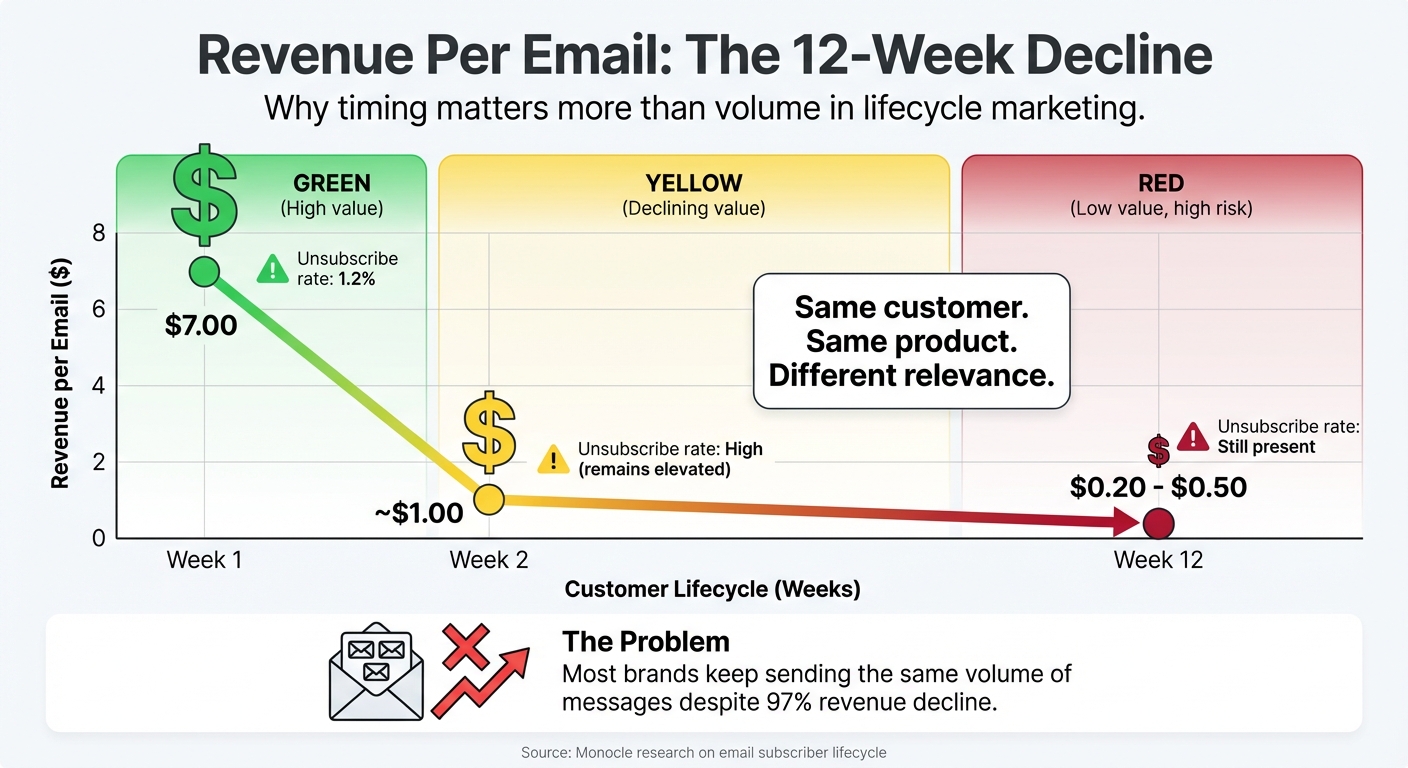
Take the lifecycle of an email subscriber. In the first week after signing up, revenue per email averages $7, with an unsubscribe rate of 1.2%. Fast forward to week 12, and that revenue plummets to just $0.20 to $0.50 per email. Despite this decline, many brands keep sending the same volume of messages, clinging to the idea that consistency is always beneficial. But when the costs – like higher unsubscribe rates – outweigh the returns, the approach can backfire. High engagement doesn’t always mean high value, and in some cases, it can actively harm your bottom line. This disconnect between activity and actual outcomes highlights the need for a smarter approach to lifecycle marketing.
Activity vs. Intelligence
If brands want to boost revenue per message, they need to stop focusing on how much they’re doing and start focusing on how well they’re doing it. This means shifting from communication activity to decision intelligence. Activity measures how busy you are. Intelligence measures how effective your decisions are. Unfortunately, most lifecycle teams focus on the former and neglect the latter.
Jess Chan, Founder & CEO of Longplay, explains it clearly:
“Winning brands start with the entire customer lifecycle, identify where they’re losing customers and revenue, and then use their CRM to systematically move more people through each stage”.
This shift requires moving away from output-focused metrics (like messages sent) and instead prioritizing outcomes (like customer retention and revenue growth).
| Activity Metrics | Value-Driven Metrics |
|---|---|
| Open rate and click-through rate | Revenue generated per subscriber |
| Total page views | % growth in qualified traffic |
| Total likes and shares | Lead conversion rate from social channels |
| Cost Per Click (CPC) | Return on Ad Spend (ROAS) |
Activity metrics might make your efforts look productive, but they don’t necessarily show the impact on your business. The numbers tell the story: only 23% of marketers feel confident they’re tracking the right KPIs, and just 3% of CMOs can attribute more than half of their marketing spend using ROI metrics. This isn’t just a data issue – it’s a matter of making better decisions.
The future of lifecycle marketing belongs to brands that stop optimizing for the sheer number of messages sent and start focusing on the value each message delivers. That means adopting metrics like revenue per message, which balances the revenue generated with the number of messages sent. It’s a metric that forces teams to rethink their strategies and aim for smarter, more impactful decisions at every step.
Why Revenue Per Message Is a Better Lifecycle Marketing Metric
Revenue per message simplifies complex metrics into a straightforward formula: total revenue divided by total messages sent. But its simplicity stops there. This metric pushes lifecycle marketing teams to answer a tough question: Are your messages truly driving revenue, or are they just creating noise?
Unlike metrics like open rates or clicks, which focus on effort, revenue per message zeroes in on results. It doesn’t just track activity; it measures whether your lifecycle marketing efforts are actually delivering returns or merely exhausting your audience. Let’s break down how this metric reshapes the way we define success in lifecycle marketing.
How Revenue Per Message Works
Here’s an example to illustrate: You send 10,000 messages and generate $50,000 in revenue, giving you a revenue per message of $5. But if you double your messages to 20,000 while revenue stays at $50,000, your revenue per message drops to $2.50. Sending more messages without improving their impact reduces efficiency.
Revenue per message often starts strong. For instance, during the first week of a subscription, it averages $7.00 per email. By the second week, it drops to about $1.00, and by week 12, it levels out between $0.20 and $0.50. The product and customer remain the same – the difference lies in how relevant the messages feel.
Improving this metric isn’t just about sending more. It’s about when to send and, just as importantly, when not to. Each unsubscribe represents lost future revenue and increases the cost of acquiring a replacement contact. To boost revenue per message, you can either increase the value of each message (the numerator) or eliminate low-value sends (the denominator). Both approaches lead to more efficient and impactful lifecycle marketing.
Understanding revenue per message in this way sets the stage for a smarter, more effective lifecycle strategy.
How Revenue Efficiency Drives Lifecycle Success
Focusing on revenue per message doesn’t just improve one metric – it has a ripple effect across your entire marketing strategy. Customers receive fewer irrelevant messages, creating a better overall experience. Reduced message fatigue means lower churn, while profitability grows as you generate the same (or more) revenue with fewer sends.
Take the revenue-to-unsubscribe ratio as an example. In week one, revenue per email hits $7.00, with an unsubscribe rate of 1.2%. The tradeoff makes sense here – the revenue outweighs the risk. But by weeks two and three, revenue drops significantly while the unsubscribe risk remains high. Sending messages during these periods can harm your list health without delivering enough return to justify the effort. Brands that carefully monitor these trends and adjust their strategies stand out.
When you prioritize smarter decisions, every message becomes more than just activity – it becomes a driver of meaningful results. Instead of counting campaigns, you start asking, “Was this campaign worth it?” By measuring engagement alongside commercial outcomes, you can cut through the noise and focus on what truly matters: delivering measurable business impact.
The Hidden Costs of Low-Value Messaging
Most teams treat unsubscribes as just another number on a dashboard, overlooking the financial hit behind each lost customer. Every unsubscribe isn’t just a disengaged user – it’s a permanent loss of someone you can no longer reach. That means no future revenue from that channel and a higher cost to acquire a replacement customer. Here’s a striking example: in the first week after a customer joins your list, the average revenue per email is $7.00, but the unsubscribe rate is 1.2%. While this early stage can justify the risk for the potential reward, the dynamic quickly shifts. As revenue per email declines in the following weeks but unsubscribe risks remain high, continuing to send messages can harm your list without enough return to make it worthwhile. In short, every unsubscribe not only reflects disengagement but also triggers an expensive hunt for new customers.
On top of that, irrelevant messaging erodes customer trust, which only makes the problem worse.
How Irrelevant Messages Drive Churn
Customers don’t unsubscribe because they suddenly dislike your brand – they leave because your messages stop being useful or meaningful. Imagine receiving multiple emails in one week promoting products you’ve already bought or discounts for items you’ve never cared about. It’s frustrating, right? Over time, this kind of misalignment chips away at trust. What starts as helpful communication turns into noise, and eventually, even one extra email can push someone to hit “unsubscribe.”
This problem runs deeper than individual messages – it affects how people view your brand. When companies rely heavily on batch emails or one-off discounts to hit short-term goals, they risk training customers to wait for sales instead of buying at full price. Premium brands, in particular, can lose their edge, as customers become more price-focused and profit margins shrink. As lifecycle experts Luke Kline, Carlos Govantes, and Phi Pham explain:
“If you only focus on heavy batch sends or one-off offers to drive conversions and sales, those tactics can and will lose effectiveness quickly”.
And it’s not just about losing customers. Poor messaging strategies can take a serious toll on profitability.
The Financial Cost of Message Waste
Low-value messaging impacts three key areas: acquisition costs, profit margins, and customer lifetime value. Every customer who churns requires additional spending to replace. Every sale driven by a discount eats into your profits. And every irrelevant email shortens the relationship with your customer.
Let’s break this down. Say you send an email that generates $0.30 in revenue but carries a 0.5% unsubscribe risk. You’re trading long-term revenue for a tiny short-term gain. A smarter move? Skip that email and wait for a better opportunity – like a natural replenishment cycle – when customers are more likely to engage with less risk of churn. Brands that treat unsubscribes as a financial cost, not just a statistic, make better decisions about when to send and when to hold back.
These hidden costs highlight why improving lifecycle messaging isn’t optional – it’s essential for driving sustainable growth in revenue per message.
How Better Decisioning Creates Higher Message Value
The quality of decision-making is what truly elevates the value of a message, translating directly into stronger revenue outcomes. The difference between a message earning $7.00 versus $0.30 isn’t about flashy creative or a clever subject line – it’s about making the right call on whether to send it at all. Better decision-making involves knowing when a customer is ready to engage, understanding what product aligns with their needs, and evaluating whether the timing is worth the risk of losing their interest. When these decisions improve, revenue per message naturally increases, creating a ripple effect across the entire customer lifecycle.
The Role of Timing and Personalization
Timing is everything when it comes to reaching customers. Messages sent when customers are most likely to buy – such as during replenishment cycles (commonly around weeks 9, 18, and 26) – align with the natural revenue curve and deliver better results.
Advanced lifecycle systems focus on intent-based triggers instead of rigid, calendar-driven schedules. These systems identify high-value moments when customers are already in a buying mindset, dramatically improving the balance of reward versus risk. On the flip side, sending messages during low-value periods can backfire, driving up unsubscribe rates and lowering average revenue per message without generating meaningful sales.
Personalization enhances these efforts. Tailored call-to-actions significantly boost performance, and research shows that 91% of consumers are more likely to shop with brands that acknowledge and remember them. The combination of precise timing and personalized content creates messages that resonate deeply with customers.
Optimizing Customer-Product Fit
Timing alone isn’t enough – offering the right product is just as critical. Even perfectly timed messages fall flat if the product doesn’t meet the customer’s needs. Customer-product fit is at the heart of effective decision-making. Smarter systems ensure that messages target customers who have shown recent interest in a particular product category. This requires analyzing detailed data like purchase history, browsing behavior, and the relationships between products.
As one expert puts it:
“The best messages can’t fix a disjointed experience”.
Brands that focus on reinforcing behaviors tied to long-term value – such as completing onboarding processes or encouraging a second purchase – build stronger customer relationships and increase lifetime value. For example, personalized welcome series tailored to specific customer entry points have been shown to boost engagement by up to 240%. The real secret lies in aligning the right product with the right customer at the right moment, rather than simply sending more messages and hoping for results.
Why the Best Lifecycle Systems Know When Not to Send
The most effective lifecycle systems embrace a surprising truth: sometimes the smartest move is to send nothing at all. Every message carries a hidden cost – the risk of losing a customer’s attention, trust, or desire to stay subscribed. When the potential revenue from a message doesn’t outweigh this risk, holding back becomes the better choice.
The Value of Suppression in Lifecycle Marketing
Sophisticated systems understand the importance of restraint. They weigh the potential revenue of a message against the risk of driving customers away, prioritizing long-term success over short-term gains. Suppression isn’t about doing less – it’s about making smarter decisions. These systems treat unsubscribes as a real financial hit, not just a statistic to analyze after the fact.
This approach is especially critical during the early weeks of customer engagement. Data shows that unsubscribes spike early, with weeks 2 and 3 being particularly risky. During this period, revenue per email often drops to around $1.00, while the risk of losing subscribers remains high. This creates a dangerous “low return, high cost” scenario where over-sending can cause significant harm. Suppression during these windows helps protect both customer trust and long-term revenue.
“Every person who leaves your list is someone you can’t reach again, which means lower future revenue and incremental acquisition cost to replace them.” – Monocle
Advanced lifecycle systems calculate a risk-reward ratio similar to financial models. They divide expected revenue by the unsubscribe rate to determine if a message is worth sending. If the ratio turns negative, the system holds back. This isn’t about cutting back randomly – it’s about preserving customer relationships and avoiding unnecessary churn. By skipping low-value sends, these systems improve the overall efficiency of their messaging strategy.
Knowing when to hold back is just as important as knowing when to send. Suppression not only protects relationships but also strengthens the foundation for future interactions.
When Skipping a Message Improves Outcomes
Once the importance of suppression is clear, the next question is: when does choosing not to send actually improve results? Customers showing signs of frustration or disengagement are prime examples. Sending more messages to these individuals often leads to unsubscribes, further damaging long-term revenue potential. In these cases, silence is the better option.
Similarly, some customers don’t need a push to make a purchase – they were going to buy anyway. Sending them a discount or promotional message doesn’t generate extra revenue; it simply eats into your margins. Holdout groups can help identify these situations, showing when a message is unnecessary and when skipping it protects profitability.
The most effective lifecycle teams focus on customer habits, not just clicks. They zero in on the 3 to 5 key actions that drive long-term value and design their messaging to support those behaviors. Low-value sends that don’t align with these goals are suppressed, ensuring that every message serves a purpose. This strategy acknowledges that trust is built over time, and unnecessary messages can chip away at that trust.
“The single worst mistake that teams can make is solely optimizing for opens, clicks, and conversions. Great lifecycle teams try to build trust with every message.” – Luke Kline, Carlos Govantes & Phi Pham, Lifecycle Leaders
The best lifecycle systems excel not just at deciding when to send but also at recognizing when not to. By continuously evaluating whether each message will strengthen or weaken the customer relationship, these systems ensure that every communication adds value. This careful balance has a direct impact on the overall efficiency and effectiveness of revenue per message calculations.
How AI Drives Revenue Per Message Through Individualized Decisioning
Transitioning from suppression logic to focusing on revenue optimization demands a fresh perspective on lifecycle decision-making. At the center of this shift is AI, which elevates decision quality by delivering smarter, personalized choices at scale. AI decisioning moves past static rules and manual testing, offering dynamic, tailored decisions – all without increasing workload or operational complexity. The outcome? Higher revenue per message through improved timing, better product alignment, and sharper commercial insights across countless customer interactions.
AI Decision Engines vs. Static Rules
Traditional lifecycle systems operate on rigid, predefined rules. For example, a customer who buys Product A might automatically receive Email B three days later. These systems are both inflexible and labor-intensive, requiring constant manual updates. AI decision engines, on the other hand, take a completely different approach. Using reinforcement learning, they continuously test and refine decisions – such as the best offer, channel, timing, or creative elements – that maximize revenue per message for each customer. This concept, termed “next best everything” by Braze, optimizes multiple variables simultaneously rather than focusing solely on a single product recommendation.
Unlike rule-based systems that react to predefined triggers, AI systems adapt in real-time to factors like seasonal trends, inventory changes, and emerging patterns. This eliminates the “manual testing tax”, where marketers constantly tweak campaigns to stay relevant. For lifecycle teams, this means fewer hours spent on maintenance and more time devoted to strategy and achieving business goals.
Key AI Capabilities for Lifecycle Optimization
AI decisioning enhances revenue per message by leveraging three main capabilities: reasoning, synthetic data generation, and individualized decision-making.
- Reasoning: AI doesn’t just respond to customer actions – it interprets them. For instance, it can predict why a customer might be ready to buy again or why offering a discount might be unnecessary. This ability to make commercially sound decisions is crucial, especially when customer behavior is unpredictable or incomplete.
- Synthetic Data Generation: Retail often suffers from incomplete or sparse customer data. AI addresses this by generating synthetic patterns to fill in the gaps, strengthening decision-making models when real data is insufficient. This is especially helpful for new customers, infrequent buyers, or product categories with limited purchase histories.
- Individualized Decision-Making: Instead of lumping customers into broad segments, AI treats each individual as a unique case. By analyzing purchase habits, browsing behavior, and lifecycle signals, it determines the best action for each customer at the perfect moment. This precision drives higher revenue per message by focusing on individual potential rather than generalized assumptions.
These capabilities enable businesses to scale personalized messaging, a key factor in increasing revenue per message.
Scaling 1:1 Personalization with AI
The real challenge for most lifecycle teams isn’t proving that 1:1 personalization works – it’s figuring out how to scale it. AI enables businesses to manage millions of personalized customer journeys without adding to their workload.
For example, in May 2025, optical retailer Now Optics used SAP Engagement Cloud’s AI-powered tools to automate subject lines and product suggestions across email and SMS campaigns. This approach led to a 5–10% increase in open rates and a 0.1–2% boost in click-through rates, all while easing the workload for creative and CRM teams.
AI also removes creative bottlenecks. Generative AI can transform a single creative brief into countless variations of subject lines, copy, and visuals in seconds. This allows teams to reach millions of micro-segments without increasing staff. In August 2023, career platform Jopwell utilized Intuit Mailchimp’s AI-powered tools to sort vast audience data and generate actionable insights. By targeting campaigns to specific demographics, Jopwell achieved an impressive email open rate of nearly 30%, well above the 21% industry average for recruiting.
The data underscores this trend: 73% of marketers agree that AI is crucial for creating personalized customer experiences, and 89% of business leaders see personalization as critical to their success over the next three years. The hyper-personalization market is expected to grow from $21.8 billion in 2024 to nearly $49.6 billion by 2029. By optimizing every customer interaction, AI decisioning ensures that each message maximizes its revenue potential, shifting the focus from sheer volume to meaningful value. AI decisioning isn’t a concept for the future – it’s the foundation for lifecycle teams aiming to boost revenue per message without adding operational complexity.
The Future of Lifecycle Marketing: Efficiency Over Activity
From Volume to Value
The rules of lifecycle marketing are evolving. For years, success was measured by sheer output – more campaigns, more automations, more messages. But the brands poised to lead in the future aren’t the ones sending the most; they’re the ones driving the most revenue from every interaction.
This shift from focusing on quantity to prioritizing quality is already happening. By 2025, 85% of lifecycle marketers will have increased their use of AI, with 45% describing the growth as “huge”. Budgets are moving away from acquisition-heavy strategies and shifting toward full-funnel lifecycle investments, with retention now seen as a major revenue driver. High-volume, one-size-fits-all messaging strategies only add to customer fatigue, leading to higher churn rates and costly reacquisition efforts. True efficiency lies in focusing on what actually moves the needle.
“Opens and clicks are cute, but what’s reducing churn? What’s driving expansion? What’s contributing to revenue? Those are your real metrics.”
The numbers back this up. Email revenue typically peaks during the first week, averaging $7 per email, but then plummets to just $0.20–$0.50 in the following weeks. At the same time, unsubscribe rates remain high during these low-revenue periods, creating a poor risk-to-reward balance. Brands that continue to send during these unprofitable windows risk alienating customers and losing future revenue for minimal short-term gains. The brands that will thrive are those that treat unsubscribes as a financial loss and optimize for a better revenue-to-unsubscribe ratio, rather than simply increasing message volume. This shift toward value-driven efficiency creates the perfect environment for AI to reshape lifecycle marketing.
The Role of AI in Defining the Future
As the focus shifts from volume to value, AI becomes the driving force behind smarter, more effective decision-making. It transforms lifecycle marketing from a reactive process – analyzing past performance – into a proactive one that predicts future outcomes. AI pinpoints the best timing for each individual, identifies high-value opportunities like replenishment cycles, and steers clear of “dead zones” where messages are more likely to lead to unsubscribes than sales. By anticipating the right moment and message for every interaction, AI boosts revenue per message.
This isn’t about replacing human expertise but eliminating the manual roadblocks that slow teams down. AI ensures messages are sent when recipients are most likely to act. It replaces traditional RFM segmentation with predictive models that detect subtle behaviors signaling churn or upgrade potential in real time. It also automates the creation of countless message variations needed for true one-to-one personalization.
Replenit exemplifies how AI can amplify existing systems. Acting as an intelligence layer, it integrates with a retailer’s current platforms to continuously determine the best lifecycle action for each customer. It draws on behavior patterns, purchase histories, product relationships, and lifecycle signals to guide decisions. Rather than replacing CRMs or marketing automation tools, it enhances their effectiveness. Even when data is incomplete, Replenit uses synthetic data and AI reasoning to improve decision-making. The outcome? Fewer messages, greater relevance, and higher revenue per interaction. The future of lifecycle marketing isn’t about sending more – it’s about making smarter choices.
FAQs
How can I calculate revenue per message accurately?
To figure out revenue per message, simply divide the total revenue from a messaging campaign by the total number of messages sent. For example, if your campaign brings in $10,000 and you send 2,000 messages, the revenue per message would be $5.
Make sure you’re calculating this using the revenue directly linked to the campaign and counting every message sent. This will give you a clear picture of how effective your messages are.
How do I know when not sending is the better choice?
Sometimes, the best choice is to skip sending a message, especially if it’s unlikely to drive meaningful revenue or could lead to unsubscribes. Instead of prioritizing the number of messages sent, focus on revenue per message. Sending irrelevant or poorly timed messages can damage both engagement and trust. Leveraging AI-driven decision-making can help determine when staying silent is the smarter move. This approach ensures every message delivers value, minimizes waste, and strengthens customer relationships.
How can AI improve revenue per message without more messages?
AI boosts revenue per message by refining how decisions are made for every interaction. It sifts through customer data – like behavior patterns, past purchases, and personal preferences – to craft messages that are timely, relevant, and effective. By cutting out redundant communications and emphasizing quality instead of quantity, AI not only minimizes wasted effort but also helps avoid overwhelming customers. This approach ensures each interaction delivers maximum value without ramping up the number of messages sent.